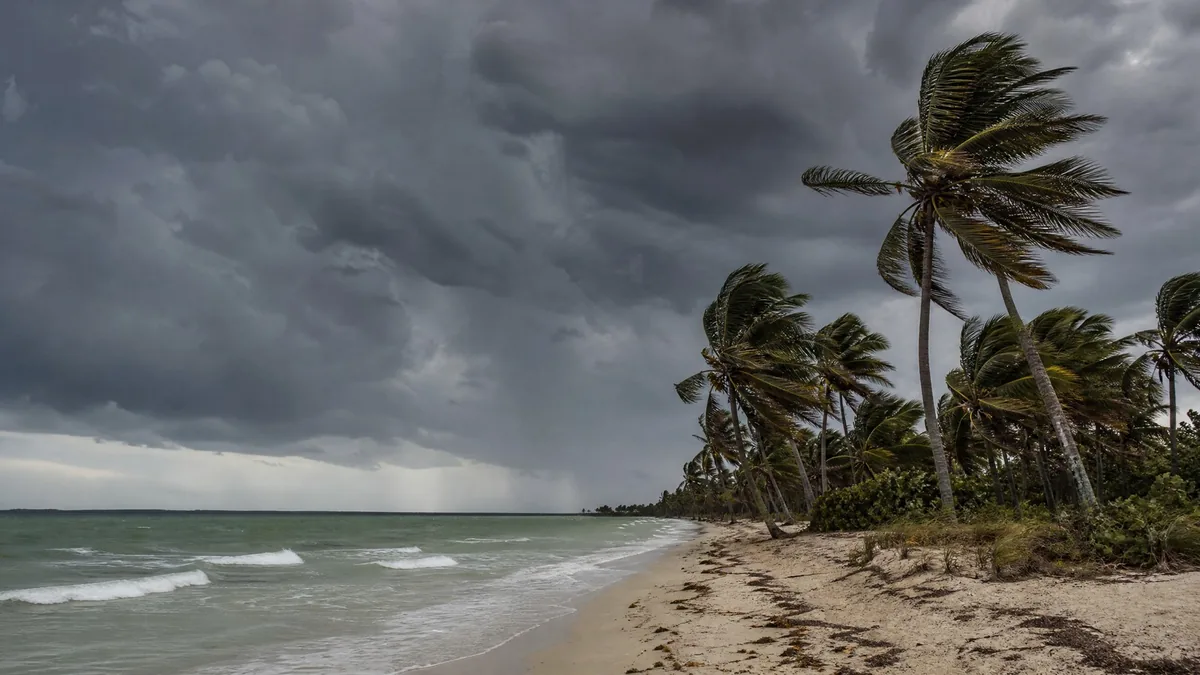
Hurricane, typhoon and cyclone seasons by island

Runs the scoring program behind every ranking on the site, and writes the world, month and traveler lists that come out of it.
UpdatedThis page carries dated prices, schedules or seasonal facts checked on the date above, and that window has now passed. Re-check the sources at the foot of the page before you book.
A hurricane, a typhoon and a tropical cyclone are the same kind of storm. The name depends on the ocean. The NOAA National Hurricane Center defines a hurricane as a tropical cyclone with sustained winds of 74 mph (119 km/h) or more; in the western Pacific the same storm is a typhoon, and in the South Pacific and Indian Ocean a cyclone.
About half the islands on this site sit in one of five storm basins. Each has an official season, and the risk inside it is far from even: a week in July and a week in mid-September are different bets. This guide sets out the seasons, the months that matter, what the 2025 and 2026 seasons did to islands on our list, and how to insure a trip. Our rankings use the same seasons; see how we score islands.
At a glance
- Atlantic and Caribbean
- June 1 to November 30, peak around September 10 (NOAA)
- Hawaii
- June 1 to November 30 (Central Pacific Hurricane Center)
- Philippines (Palawan)
- Rainy season June to November; nearly 70% of typhoons form July to October (PAGASA)
- Fiji and Bora Bora
- November to April, peak January to March; 2026/27 forecast above average
- Mauritius
- Cyclone summer November to April, peak in January
- No cyclone season
- Greece, Italy, Spain, the Canaries, Thailand, Bali, the Maldives, Zanzibar
In this guide
Atlantic: the Caribbean, the Bahamas, Bermuda and the US islands
The Atlantic season runs June 1 to November 30, per the NOAA National Hurricane Center. The peak is around September 10, and most activity falls between mid-August and mid-October. In the 1991 to 2020 averages, a season brings 14 named storms, 7 hurricanes and 3 major hurricanes. It covers every Caribbean island we rank, the Bahamas, Bermuda, Key West, Hilton Head, Nantucket, Cozumel and Roatán. Even the Azores feel it: Lorenzo brought hurricane-force winds to Flores and Corvo in early October 2019.
Risk is not equal across the region. Our island writers counted storm centers passing within 50 nautical miles (58 miles) since 1950 in NOAA's HURDAT2 records. Curaçao had one hurricane, Felix in 2007; Aruba and Bonaire had two each, Anna in 1961 and Felix. Barbados had six, most recently Elsa in 2021, and Grenada six, including Beryl, which made landfall on Carriacou as a Category 4 on July 1, 2024. Low risk is not no risk.
The last two seasons left marks. Hurricane Melissa struck western Jamaica in late October 2025. A year on, the Jamaica Tourist Board lists the airports and cruise ports as operating, but seven large Montego Bay resorts stay closed until 2027. Late October is not safe by default. See our Jamaica page.
Central Pacific: Hawaii
Hawaii's season also runs June 1 to November 30, per NOAA's glossary, with warnings issued by the Central Pacific Hurricane Center. It is a quieter basin than the Atlantic. NOAA counts 163 tropical systems in the central Pacific from 1971 to 2008, about four a year, of which 36% were hurricanes.
2026 was the exception. Hurricane Lala in mid-August was the first direct hurricane impact on the Big Island since 1871, with flash floods in the Kau district. Hurricane Lowell passed over Niihau and Kauai on September 7 and 8, the first direct hit on Kauai since Iniki in 1992, with an early damage estimate above $400 million; its outer bands killed one man and cut power to about 21,000 customers on Oahu. Hurricane Nolo passed south of the islands in late September, cutting power to more than 12,000 customers on Maui, feeding a brush fire at Olowalu and flooding Kau again.
On October 19, 2026, Hawaii's state parks division still listed Koke'e Road and every Kauai state park except Haena and part of Wailua River as closed, and some Big Island sites, including Lapakahi, closed for fallen trees. Check the parks division's notices before you book.
Western Pacific: typhoons and Palawan
The Philippine weather service, PAGASA, says about 20 tropical cyclones enter its area of responsibility in a year and 8 or 9 cross the country, with nearly 70% of typhoons developing from July to October. Its rainy season runs June to November and the dry season December to May. Typhoons form near the Mariana and Caroline Islands and track northwest. For Palawan that makes December to May the safe window, which is also its best weather.
South Pacific: Fiji and Bora Bora
The Fiji Meteorological Service, the regional center at Nadi, puts the season at November to April, with the peak usually in January and February across the region and January to March for Fiji. Météo-France in French Polynesia gives the same months, sometimes into May.
2026/27 is forecast to be busy. Because a strong El Niño is established, the Nadi center expects 11 to 15 cyclones across its area, against an average of about seven. East of the Dateline, where Bora Bora sits, it expects 8 to 10 (average about four), four or five of them severe. West of the Dateline, it expects five or six. For Fiji itself, two or three are likely to pass through its waters, near the normal of about two, with one or two severe. If you are booking Fiji or Tahiti for January to March 2027, insure the trip.
Indian Ocean: Mauritius, the Seychelles, the Maldives and Zanzibar
In the southwest Indian Ocean, cyclones form in the southern summer. Mauritius Meteorological Services describes a warm, humid summer from November to April, with February and March the wettest months. The Seychelles Meteorological Authority says the season peaks in January and is officially over by April. Mauritius is the exposed island; the Seychelles' granitic islands are rarely affected, because storms normally curve south first.
The Maldives and Zanzibar plan around monsoons, not cyclones. The Maldives' wet southwest monsoon runs from mid-May to November. Zanzibar has two rainy seasons, the long rains in spring and the short rains from about October to December, which the Tanzania Meteorological Authority expects to run longer than usual in 2026, into January 2027.
Islands with no hurricane season, and what they get instead
- The Mediterranean. No hurricane season, but rare tropical-like storms called medicanes, most common from September to January. Storm Daniel brought floods in September 2023, and Blas struck the Balearics and Sardinia in November 2021. Summer brings wildfire risk; the July 2023 fires on Rhodes forced Greece's largest evacuation.
- The Canaries. Outside the usual tracks, though NOAA's report on Hermine says its remnants brought record rainfall and flooding in September 2022.
- Thailand. Monsoons. On the Andaman coast (Phuket, Phi Phi, Koh Lanta), the southwest monsoon arrives around mid-May and rain peaks in September. On the Gulf (Koh Samui), the heaviest rain comes from about mid-October to early December.
- Bali. A wet west monsoon from about October to April, heaviest from December to March.
The risk month by month
These are the storm deductions our rankings take from a month's weather score, out of 10. They follow the official seasons and the months each basin's own service names as its peak. A dash means no deduction. Aruba, Curaçao, Bonaire, Grenada and Barbados take half the Atlantic figure.
| Month | Atlantic | Hawaii | W. Pacific | S. Pacific | SW Indian |
|---|---|---|---|---|---|
| January | - | - | - | 1.2 | 1.0 |
| February | - | - | - | 1.4 | 1.2 |
| March | - | - | - | 1.2 | 1.0 |
| April | - | - | - | 0.5 | 0.4 |
| May | - | - | - | - | - |
| June | 0.6 | - | - | - | - |
| July | 0.8 | 0.3 | 0.8 | - | - |
| August | 2.0 | 0.6 | 1.2 | - | - |
| September | 2.5 | 0.6 | 1.2 | - | - |
| October | 1.8 | 0.3 | 1.0 | - | - |
| November | 0.6 | - | 0.8 | - | - |
| December | - | - | - | 0.8 | 0.6 |
In practice: for the Caribbean, December to May is the low-risk half of the year; June, July and November are moderate; August to October is the peak. Our month rankings show the effect, from September, when no Caribbean island makes our top ten, to December, when the Caribbean takes the top three. These are long-run averages: 2026 in Hawaii shows that a quiet basin can have a bad year.
Travel insurance for storm season
The State Department is blunt: the US government does not pay medical bills abroad, and Medicare does not cover care outside the United States. It says medical evacuation by air ambulance back to the US can cost from $20,000 to $200,000, and that most health plans will not pay for it. It lists two separate products: trip cancellation insurance, which helps you get money back if you have to cancel or change plans but usually does not pay medical costs abroad, and medical evacuation insurance, which it strongly recommends for places with limited medical care.
For a storm-season trip, read the policy for four things before you pay:
- Whether a hurricane or cyclone counts as a covered reason to cancel or cut a trip short, and whether a warning is enough or the storm must hit.
- Whether your hotel closing, or your destination being declared uninhabitable, triggers a refund.
- When cover starts, and how the policy treats a storm that has already formed when you buy. Buying soon after you book avoids the question.
- Evacuation and medical limits, for small islands where serious care means a flight.
US islands need no passport, but they are still in storm basins: Hawaii, Puerto Rico and the US Virgin Islands all sit inside the June-to-November seasons. Our passport guide covers entry; this page covers the weather.
Frequently asked questions
When is hurricane season in the Caribbean?
June 1 to November 30, per the NOAA National Hurricane Center, with a peak around September 10 and most activity from mid-August to mid-October.
Which Caribbean islands are outside the hurricane belt?
None is fully outside it. Curaçao, Aruba and Bonaire, off Venezuela, have had the fewest hurricane centers pass close since 1950: one or two each. Grenada, at the southern end of the island chain, still had six in the same period, including Beryl in 2024.
Does Hawaii get hurricanes?
Rarely a direct hit, but it happens. Hawaii's season runs June 1 to November 30. In 2026, Hurricane Lala hit the Big Island in August and Hurricane Lowell hit Kauai on September 7 and 8, the first direct hit there since Iniki in 1992.
When is cyclone season in Fiji?
November to April, with the peak usually January to March for Fiji, per the Fiji Meteorological Service. It forecasts an above-average 2026/27 season across the region, with two or three cyclones likely near Fiji.
Should I buy travel insurance for hurricane season?
Yes, for any trip from August to October in the Atlantic or Central Pacific and from December to March in the South Pacific or southwest Indian Ocean. Buy it soon after booking, and check that storms are a covered reason to cancel.
Do Greece and Thailand have a hurricane season?
No. Greece has rare Mediterranean storms and summer wildfire risk; Thailand has monsoons, with the Andaman coast wettest around September and the Gulf coast from mid-October to early December.
Further reading
Official sources
- NOAA National Hurricane Center - Tropical cyclone climatology – Atlantic season June 1 to November 30, peak September 10, most activity mid-August to mid-October; 1991-2020 averages of 14 named storms, 7 hurricanes, 3 major; 163 central Pacific systems 1971-2008, 36% hurricanes; checked October 20, 2026
- NOAA National Hurricane Center - Glossary – Hurricane defined at 64 knots (74 mph, 119 km/h); Central Pacific season June 1 to November 30; checked October 20, 2026
- NOAA National Hurricane Center - HURDAT2 best-track data – Basis for our counts of storm centers within 50 nautical miles of Curaçao, Aruba, Bonaire, Barbados and Grenada since 1950; checked October 20, 2026
- NOAA National Hurricane Center - Tropical Cyclone Report: Hurricane Beryl – Category 4 landfall on Carriacou, July 1, 2024; checked October 20, 2026
- PAGASA - Tropical cyclone information – About 20 tropical cyclones a year in the Philippine area of responsibility, 8 or 9 crossing, nearly 70% July to October; checked October 20, 2026
- PAGASA - Climate of the Philippines – Rainy season June to November, dry season December to May; checked October 20, 2026
- Fiji Meteorological Service (RSMC Nadi) - 2026-27 Tropical Cyclone Seasonal Outlook – Season November to April; 11 to 15 TCs regionally (average about 7); 8 to 10 east of the Dateline, 4 to 5 severe; 5 to 6 west; 2 to 3 for Fiji; strong El Niño; checked October 20, 2026
- Mauritius Meteorological Services - Climate of Mauritius – Summer November to April; wettest months February and March; checked October 20, 2026
- Seychelles Meteorological Authority - Seychelles Climate Guide – Cyclone season peaks in January, over by April; granitic islands rarely affected; checked October 20, 2026
- US Department of State - Your health abroad – US government does not pay medical bills abroad; Medicare does not cover care outside the US; air ambulance $20,000 to $200,000; checked October 20, 2026
- US Department of State - Travel insurance – Trip cancellation versus medical evacuation insurance; checked October 20, 2026
- Hawaii Division of State Parks - Important park notices – Kauai and Big Island closures as of October 19, 2026; checked October 20, 2026
- Wikipedia - Hurricane Lowell – Kauai direct hit September 7-8, 2026; damage estimate above $400 million; Oahu death and outages; checked October 20, 2026
- Wikipedia - Hurricane Lala – Mid-August 2026, first direct hurricane impact on the Big Island since 1871; checked October 20, 2026
- Wikipedia - Hurricane Nolo – Late September 2026: Maui outages and Olowalu fire, Kau flooding; checked October 20, 2026
- Jamaica Tourist Board - Travel alerts – Airports and seaports operating after Hurricane Melissa; checked October 20, 2026